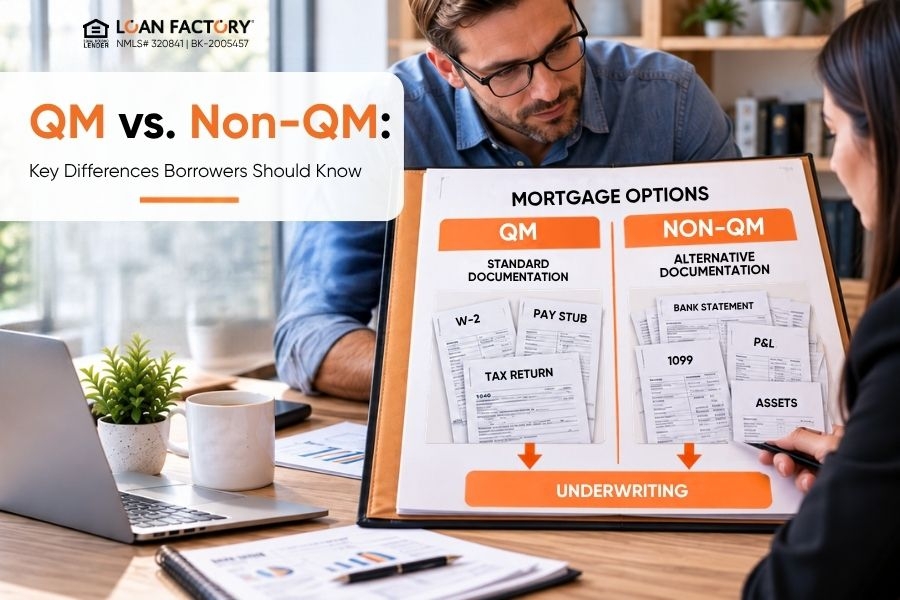
A bank statement loan is a mortgage that allows eligible self-employed borrowers to document income using deposits shown on personal or business bank statements instead of relying primarily on W-2s, pay stubs, or traditional tax-return calculations.
These loans are commonly offered through non-QM or non-agency programs. They can be useful when your business generates consistent cash flow, but tax deductions make your reported taxable income look lower than the income available to support a mortgage.
At Loan Factory, we help you compare bank statement mortgage programs, understand how lenders calculate your income, and prepare the documents needed for a home purchase or refinance.
Key Takeaways Bank statement loans commonly use 12 or 24 months of personal or business deposits to calculate income. These programs are primarily designed for self-employed borrowers, business owners, freelancers, and eligible 1099 earners. A bank statement loan is an alternative-documentation mortgage, not a no-income or no-document loan. Credit, debts, down payment or equity, reserves, property details, and housing payment history still affect qualification. Important Note: Bank statement loan requirements, income calculations, rates, fees, loan-to-value limits, reserves, property rules, and available terms vary by lender and investor. This article is for educational purposes and is not a commitment to lend.
How Does a Bank Statement Loan Work? A bank statement loan works by analyzing recurring deposits over a specified period, commonly 12 or 24 months. The lender identifies eligible income, excludes transfers and other non-income deposits, applies any required business expense adjustment, and calculates an average monthly income for underwriting.
Traditional mortgage underwriting often relies on documents such as:
W-2 forms Pay stubs Personal tax returns Business tax returns K-1 forms IRS transcripts A bank statement mortgage uses an alternative method to document qualifying income.
The lender still reviews your complete financial profile, including:
Self-employment history Deposit consistency Credit history Monthly debts Housing payment history Down payment or home equity Funds for closing Cash reserves Property type Occupancy Loan purpose Federal ability-to-repay rules generally require mortgage lenders to make a reasonable, good-faith determination that a borrower can repay the loan. Lenders commonly review income, assets, employment, credit history, monthly expenses, and the proposed mortgage obligation.
Quick Answer: Bank statements replace traditional income documents in the calculation, but they do not replace underwriting.
Why Do Self-Employed Borrowers Use Bank Statement Loans? Self-employed borrowers use bank statement loans when their recurring business cash flow is stronger than the taxable income shown on their tax returns. Legitimate business deductions can reduce taxable income and make qualifying through conventional documentation more difficult.
Business owners commonly deduct expenses such as:
Equipment Advertising Business insurance Contract labor Office rent Supplies Professional services Travel Vehicle expenses Depreciation Technology Employee compensation These deductions can reduce the net income appearing on a tax return.
That can create a disconnect: the business may have consistent revenue and healthy cash flow, but a traditional mortgage income calculation may not reflect the borrower’s full financial picture.
Bank statement home loans address this issue by evaluating eligible account deposits and applying the expense method required by the selected lender.
Who Can Qualify for a Bank Statement Loan? Bank statement loans are primarily designed for borrowers who earn income outside a traditional salaried or hourly employment structure. The strongest candidates generally have an established business, consistent deposits, acceptable credit, sufficient funds, and enough calculated income to support the proposed mortgage.
Potential candidates include:
Small-business owners Sole proprietors LLC members Partnership owners S corporation shareholders C corporation shareholders Independent contractors Freelancers Consultants Commission-based professionals Real estate professionals Medical practice owners Legal professionals Restaurant owners Online business owners Gig-economy workers Eligible 1099 earners Current bank statement mortgage programs commonly focus on self-employed borrowers and allow income to be documented through personal or business statements. Program details, business ownership requirements, and minimum self-employment history differ by lender.
→ Read more: 1099 Income Loan : How Self-Employed Borrowers Qualify for a Mortgage
How Long Must You Be Self-Employed? Many bank statement mortgage lenders look for an established history of self-employment or experience in the same line of work. Some programs prefer two years, while others can consider a shorter period when the borrower has relevant prior experience and meets additional requirements.
A lender can verify the business through:
A business license Secretary of State registration Articles of organization Articles of incorporation Professional licensing Proof of business ownership A business website A CPA or tax professional letter Client contracts Current invoices Third-party business records Moving from W-2 employment to self-employment in the same industry can be evaluated differently from starting a new business in an unrelated field.
The Loan Officer must review the selected lender’s current guidelines before determining which self-employment history is acceptable.
How Many Bank Statements Do You Need? Most bank statement mortgage programs use 12 or 24 consecutive months of statements. The appropriate period depends on the lender, the program, and which timeframe presents the clearest picture of your recurring income.
Current programs commonly advertise both 12-month and 24-month documentation options.
A lender can request:
12 months of personal bank statements 24 months of personal bank statements 12 months of business bank statements 24 months of business bank statements Statements from multiple eligible accounts Additional recent statements before closing Supporting records for irregular deposits Statements generally need to be complete and consecutive.
Missing pages, altered statements, unreadable documents, or blacked-out account activity can prevent the lender from completing the income analysis. One published bank statement program specifically requires all pages and does not accept blacked-out sections.
Is a 12-Month or 24-Month Program Better? A 12-month program can better reflect recent growth, while a 24-month program can provide a longer record of stability. The better option depends on your deposit pattern, business seasonality, recent revenue changes, and the calculation used by the lender.
A 12-month review can be useful when:
Recent income is stronger The business has gained recurring contracts Current revenue better represents ongoing operations Older statements reflect a weaker business period The selected lender accepts 12 months A 24-month review can be useful when:
The business is seasonal Deposits vary from month to month The longer average demonstrates stability Revenue has remained consistent The lender requires a longer history Our Loan Officers can compare both calculations when eligible programs are available.
Can You Use Personal or Business Bank Statements? Many programs accept either personal or business bank statements, but the lender calculates qualifying income differently. Personal accounts can reflect income after business expenses, while business accounts usually contain gross revenue that must be adjusted for operating expenses.
Statement type
How lenders generally evaluate it
Personal bank statements Review eligible recurring income deposited into the borrower’s personal account Business bank statements Review gross eligible deposits and apply a business expense adjustment Multiple accounts Combine accounts when permitted and account ownership is verified Mixed personal and business accounts Treatment depends on the selected program
Personal Bank Statements Personal bank statements can work well when your self-employment income is deposited into a personal account after business expenses have already been paid.
The lender reviews:
The source of deposits Deposit consistency Account ownership Transfers from other accounts Business expenses paid from the account One-time or unusual deposits Whether income has already been counted elsewhere If a personal account contains substantial business activity, the lender can require an expense adjustment or additional documentation.
Business Bank Statements Business statements show revenue before operating costs. The lender must therefore estimate how much of that revenue is available to the borrower after legitimate business expenses.
The lender can use:
A standard expense factor An industry-based expense factor A business-specific expense calculation A CPA or tax professional expense letter A profit-and-loss statement Another method permitted by the program Some programs use a default expense percentage but allow a different calculation when supported by acceptable third-party documentation. Because methods vary, two bank statement mortgage lenders can calculate different qualifying incomes from the same deposits.
How Is Income Calculated for a Bank Statement Mortgage? Bank statement income is calculated by totaling eligible deposits, removing ineligible funds, applying any required expense adjustment, accounting for the borrower’s business ownership percentage, and averaging the resulting income over the statement period.
Personal Bank Statement Calculation A simplified calculation can look like this:
Eligible personal deposits ÷ number of months reviewed = average monthly income
Suppose a lender identifies $180,000 of eligible personal deposits over 12 months:
$180,000 ÷ 12 = $15,000 in average monthly income
This example assumes the deposits represent eligible net income and no additional expense adjustment is required.
Business Bank Statement Calculation A simplified business calculation can look like this:
Eligible business deposits × usable income percentage ÷ number of months = average monthly income
Suppose the business receives $360,000 in eligible deposits over 12 months and the lender determines that 50% is available after business expenses:
Eligible deposits: $360,000 Usable income percentage: 50% Calculated annual income: $180,000 Average monthly income: $15,000 Published lender materials demonstrate this general approach, although actual expense factors and calculations differ among programs.
Illustrative Example: This calculation is simplified for educational purposes. Actual income depends on deposit eligibility, business expenses, ownership percentage, trends, account activity, lender guidelines, and underwriting.
What Happens If You Own Part of the Business? When you own less than 100% of a company, the lender can limit qualifying income based on your ownership percentage.
The process can include:
Totaling eligible business deposits Excluding non-income activity Applying the approved expense adjustment Applying the borrower’s ownership percentage Averaging the result over the qualifying period One published lender form specifies that a borrower owning only part of the business receives the applicable ownership percentage after the business expense adjustment. Other lenders can use different methods.
Which Deposits Count as Income? Eligible deposits generally need to represent recurring revenue from your business, profession, contracts, commissions, or self-employment activity. Lenders review the source of funds carefully to avoid treating transfers, borrowed money, refunds, or other one-time transactions as ongoing income.
Potentially eligible deposits include:
Customer payments Client payments Professional fees Contract income Commission income Business revenue Merchant-processing deposits Recurring 1099 income Payments supported by invoices Other documented self-employment receipts The lender can request:
Invoices Contracts Merchant-processing statements Sales reports Payment-platform records Deposit receipts Letters of explanation Business ledgers Which Deposits Are Usually Excluded? Deposits that do not represent recurring earned income are generally removed from the calculation.
Examples include:
Transfers between your accounts Loan proceeds Cash advances Tax refunds Credit-card refunds Returned purchases Bank fee refunds Insurance proceeds Gifts Sale of personal assets Reversed transactions Unverified deposits Funds already counted in another account Published program documentation specifically identifies transfers, tax refunds, card returns, and fee refunds as items that are not counted as qualifying income.
Can Cash Deposits Count? Cash deposits can count under some programs when they are consistent with the business and supported by adequate documentation. However, unexplained cash is more difficult to verify than electronic deposits or checks tied to identifiable clients and invoices.
A cash-intensive business can need:
Point-of-sale records Customer receipts Daily sales reports Merchant statements Business ledgers Invoices A profit-and-loss statement A qualified third-party explanation Evidence that the deposit pattern matches business operations Do not assume every cash deposit will be accepted as qualifying income.
What Are the Typical Bank Statement Loan Requirements? Bank statement loan requirements generally include established self-employment, complete account records, consistent eligible deposits, acceptable credit, sufficient down payment or equity, manageable monthly debts, funds for closing, and any reserves required by the lender.
Requirement
What the lender evaluates
Self-employment Business history, ownership, and line of work Bank statements Usually 12 or 24 consecutive months Deposits Source, frequency, consistency, and trend Business expenses Standard or documented expense calculation Credit Scores, tradelines, late payments, collections, and credit events Debt-to-income ratio Monthly debts compared with qualifying income Down payment or equity Loan amount compared with the property value Reserves Funds remaining after closing Housing history Recent mortgage or rental payments Property Value, condition, occupancy, and type Loan purpose Purchase, rate-and-term refinance, or cash-out refinance
There is no universal requirement that applies to every bank statement lender.
Current published programs vary in their statement periods, credit thresholds, maximum loan-to-value limits, self-employment history, reserve requirements, and treatment of business expenses.
What Credit Score Do You Need? There is no single minimum credit score for all bank statement loans. The score required depends on the lender, loan amount, down payment or equity, property type, occupancy, loan purpose, mortgage history, and other risk factors.
Lenders also review:
Recent late payments Credit utilization Number and age of credit accounts Collections and charge-offs Mortgage or rental history Bankruptcy Foreclosure Short sale Loan modification Recent credit inquiries Disputed accounts Stronger credit can provide access to more programs, higher permitted loan-to-value ratios, and more favorable pricing.
How Much Down Payment Is Required? The required down payment varies by lender and borrower profile. Some current programs advertise up to 90% financing for qualifying purchase transactions, but maximum financing is generally reserved for stronger applications and is not available to every borrower.
You can need a larger down payment when:
Your credit score is lower The loan amount is higher The property is an investment property You are purchasing a second home Deposits are inconsistent or declining Cash reserves are limited The business is relatively new The property presents additional risk A major credit event occurred recently Are Cash Reserves Required? Many bank statement lenders require borrowers to keep liquid funds after closing. Reserves provide a financial cushion and are commonly measured as a number of months of the proposed housing payment.
Eligible reserves can include:
Checking accounts Savings accounts Money market accounts Eligible investment accounts Vested retirement assets Other approved liquid funds Reserve requirements can increase for:
Investment properties Multiple financed properties Larger mortgage amounts Cash-out refinances Lower credit scores Higher debt-to-income ratios Recent credit events Interest-only loans The lender determines which assets are eligible and how much must remain after closing.
What Documents Do You Need? A bank statement loan requires more than account statements. The lender needs enough documentation to verify your identity, business, account ownership, income pattern, assets, credit obligations, property, and ability to repay.
Common documents include:
Business and Income Documents Complete personal or business bank statements Every page for the required period Business license Articles of organization or incorporation Proof of ownership CPA or tax professional letter Profit-and-loss statement when required Business expense documentation 1099 forms when applicable Current invoices or contracts Explanations for unusual deposits Personal and Asset Documents Government-issued identification Credit authorization Current housing information Checking and savings account statements Investment or retirement statements Documentation of funds for closing Explanations for recent credit issues Bankruptcy or foreclosure documents when applicable Property Documents Purchase contract Current mortgage statement for a refinance Homeowners insurance information Property tax records Appraisal Title documents Homeowners association information when applicable Providing complete documents at the beginning can reduce questions and delays during underwriting.
Can You Buy a Home With a Bank Statement Loan? Yes, eligible borrowers can use a bank statement loan to purchase a primary residence, second home, or investment property when the selected program permits that occupancy and property type. The lender reviews calculated income, credit, debts, down payment, reserves, and the property.
A typical purchase process includes:
Reviewing your self-employment structure Identifying eligible bank accounts Calculating preliminary monthly income Comparing 12- and 24-month programs Reviewing credit and monthly debts Confirming funds for closing and reserves Determining a suitable purchase range Completing preapproval Submitting the property for appraisal and underwriting Satisfying closing conditions A preapproval is not a final approval. The lender must still verify the complete borrower, income, asset, property, title, and transaction information.
Can You Refinance With a Bank Statement Loan? Yes, bank statement refinance programs can allow eligible self-employed homeowners to document income using deposits. Depending on the lender, available structures can include rate-and-term refinancing, cash-out refinancing, and other eligible refinance transactions.
Current bank statement programs advertise both home purchase and refinance options.
Rate-and-Term Refinance A rate-and-term refinance replaces the existing mortgage without providing substantial cash proceeds.
A homeowner can consider it to:
Change the loan term Replace an adjustable-rate mortgage Change the mortgage structure Pay off eligible existing liens Remove or add a borrower when permitted Pursue a more suitable payment structure Compare the proposed rate, payment, closing costs, loan term, and total interest before proceeding.
Cash-Out Refinance A cash-out refinance replaces the current mortgage with a larger loan and allows the homeowner to access part of the available equity.
Cash-out programs can apply stricter requirements for:
Credit Mortgage payment history Loan-to-value ratio Reserves Income stability Property ownership Loan seasoning Maximum cash proceeds Because the new debt is secured by your home, evaluate the cost and long-term impact carefully.
Bank Statement Loan vs. Conventional Mortgage A bank statement loan and a conventional mortgage differ mainly in how they document self-employed income. Conventional underwriting commonly relies on tax returns and agency calculations, while bank statement programs evaluate eligible deposits and estimated business expenses.
Feature
Bank statement loan
Conventional mortgage
Income documentation Personal or business bank statements W-2s, pay stubs, tax returns, and agency-approved records Typical borrower Self-employed or eligible 1099 borrower Salaried or self-employed borrower meeting agency rules Income calculation Eligible deposits adjusted for expenses Qualifying income calculated under agency guidelines Program type Commonly non-QM or non-agency Conforming or agency-based Guidelines Vary significantly by lender More standardized Pricing Depends on alternative-documentation risk Can be more favorable for qualifying borrowers Property options Program-dependent Agency property and occupancy rules apply Best fit Strong cash flow not fully reflected by tax returns Traditional documentation supports sufficient income
A bank statement loan should not automatically replace a conventional mortgage.
At Loan Factory, we compare traditional and alternative documentation before helping you choose a path. When conventional qualification works, it can provide more favorable pricing or terms.
Bank Statement Loan vs. DSCR Loan A bank statement loan qualifies the borrower using personal or business income, while a DSCR loan typically qualifies an investment property based primarily on its rental cash flow. The right option depends on whether personal business income or property income provides the stronger qualification method.
Feature
Bank statement loan
DSCR loan
Primary qualification Borrower’s eligible deposits Investment property rental cash flow Typical borrower Self-employed homebuyer or homeowner Real estate investor Personal income review Yes, using bank statements Often not used for primary qualification Occupancy Can include primary, second home, or investment property Generally non-owner-occupied property Best use Self-employed income is strong Property cash flow supports the mortgage
A DSCR loan is not generally intended for a primary residence.
For an investment property, our Loan Officers can compare the income produced by your business with the income produced by the property.
→ Read more: No-Doc vs Bank Statement vs DSCR Loans : Which One Do You Actually Qualify For?
Benefits of a Bank Statement Loan The main benefit of a bank statement loan is that it provides a practical income-documentation method for self-employed borrowers whose tax returns do not fully reflect their recurring cash flow.
Potential benefits include:
Use of personal or business deposits 12- or 24-month documentation options Less reliance on traditional taxable income Purchase and refinance availability Options for different property occupancies Flexibility for seasonal or variable income Recognition of recurring business cash flow Access to alternative lender programs Loan Factory currently describes bank statement loans as programs that can use 12–24 months of personal or business statements instead of W-2s or tax returns for eligible self-employed borrowers.
Drawbacks and Tradeoffs Bank statement loans provide flexibility, but they can carry higher borrowing costs, larger down payment requirements, additional reserves, or more detailed deposit analysis than traditional financing. The value depends on how the program compares with your other available options.
Potential tradeoffs include:
Higher interest rates Additional lender fees Larger down payment requirements More post-closing reserves Detailed deposit documentation Exclusion of transfers and one-time deposits Business expense adjustments Possible prepayment penalties where permitted Fewer participating lenders Program-specific property restrictions The most flexible program is not always the least expensive.
Review:
Interest rate Annual percentage rate Monthly payment Closing costs Loan term Prepayment terms Cash required at closing Total borrowing cost Expected time in the property How to Prepare Before Applying Prepare by organizing complete statements, separating business and personal activity, documenting unusual deposits, reducing unnecessary new debt, and preserving funds for closing and reserves. A clear financial record helps your Loan Officer evaluate income before the file reaches underwriting.
Use these steps:
Gather complete statements. Separate business and personal accounts. Identify account transfers. Document unusual deposits. Review the income trend. Avoid altering documents. Preserve closing funds. Limit new debt. Review your credit. Compare documentation methods. How to Compare Bank Statement Mortgage Lenders Compare bank statement mortgage lenders based on their complete income methodology, not only an advertised interest rate or credit score. Expense factors, deposit exclusions, ownership calculations, reserves, and property guidelines can materially change how much income a lender recognizes.
Ask:
Does the lender use 12 or 24 months of statements? Can you use personal statements, business statements, or either? Can multiple accounts be combined? Which deposits are excluded? What expense factor applies? Can a CPA document actual expenses? How is declining income handled? How does business ownership affect income? What credit requirements apply? How much down payment or equity is required? What reserves are required? Are primary homes, second homes, and investment properties eligible? Is cash-out refinancing available? Is a prepayment penalty included? What are the lender and third-party costs? The CFPB recommends comparing Loan Estimates carefully, including the interest rate, projected payment, lender costs, cash to close, and loan features.
How Loan Factory Helps With Bank Statement Loans At Loan Factory, we help self-employed borrowers translate complex cash flow into a clear mortgage strategy. Our Loan Officers review your accounts, business structure, deposit history, credit, debts, assets, property, and goals before comparing available programs across our broad wholesale lender network.
We help you:
Compare 12- and 24-month statement programs Review personal and business bank statement options Identify eligible and ineligible deposits Understand business expense calculations Compare lender income-calculation methods Evaluate conventional and alternative documentation Review home purchase and refinance options Understand credit, equity, and reserve requirements Organize documents before underwriting Compare estimated rates, payments, terms, and closing costs Use TERA to support pricing, document collection, communication, and loan progress We explain how each option works and where the tradeoffs are, so you can make an informed mortgage decision.
Your eligibility, rate, loan amount, and terms will depend on your complete application, property, underwriting results, and the selected lender’s guidelines.
Compare mortgage options or call or text (660) 333-3333 to speak with a Loan Factory mortgage professional.
Is a Bank Statement Loan Right for You? A bank statement loan can be a strong option when you have consistent self-employment cash flow but traditional tax-return calculations do not support the mortgage amount you need. It should still be compared with conventional, P&L, 1099, asset-based, and DSCR options when relevant.
Consider these questions:
Do your deposits represent recurring business income? Are your statements complete and organized? Can you document the source of unusual deposits? How much of the business do you own? What expense factor will the lender use? Are deposits stable or declining? Do you have enough funds for closing and reserves? Can you qualify through traditional tax returns? Would another income-documentation program work better? How do the proposed rate and costs compare? The right mortgage is not simply the program that produces the highest calculated income. It is the option that fits your qualification needs, budget, property, and long-term goals.
Conclusion A bank statement loan allows eligible self-employed borrowers to qualify for a mortgage using recurring personal or business deposits instead of relying primarily on W-2s, pay stubs, or traditional tax-return calculations.
The lender still reviews your income, credit, monthly debts, assets, down payment or equity, reserves, housing history, property, and ability to repay.
At Loan Factory, we help you compare how different lenders evaluate your deposits and determine whether a bank statement mortgage or another program better fits your financial profile.
Apply online or call or text (660) 333-3333 to begin your bank statement loan review.
Experience Note When our Loan Officers review a bank statement mortgage, we do not simply add every deposit appearing in the account.
We identify recurring business income, exclude transfers and other non-income funds, review deposit trends, evaluate account ownership, apply the appropriate expense method, and compare the resulting income with the borrower’s debts, credit, assets, property, and mortgage goals.
Disclaimer: This content is for educational and informational purposes only and is not financial, tax, legal, accounting, or credit advice, a commitment to lend, or a guarantee of approval. Mortgage programs, rates, fees, payments, income calculations, documentation, and eligibility are subject to change and vary based on credit, income, assets, debts, business history, property, occupancy, loan purpose, underwriting, lender overlays, and investor guidelines.
About the Author Loan Factory Mortgage Education Team
Loan Factory is a technology-powered mortgage platform helping borrowers compare mortgage options through a broad wholesale lender network.
The Loan Factory Mortgage Education Team helps self-employed borrowers understand bank statement mortgages, alternative income calculations, business expense analysis, and the documentation required for home purchases and refinances.
Frequently Asked Questions