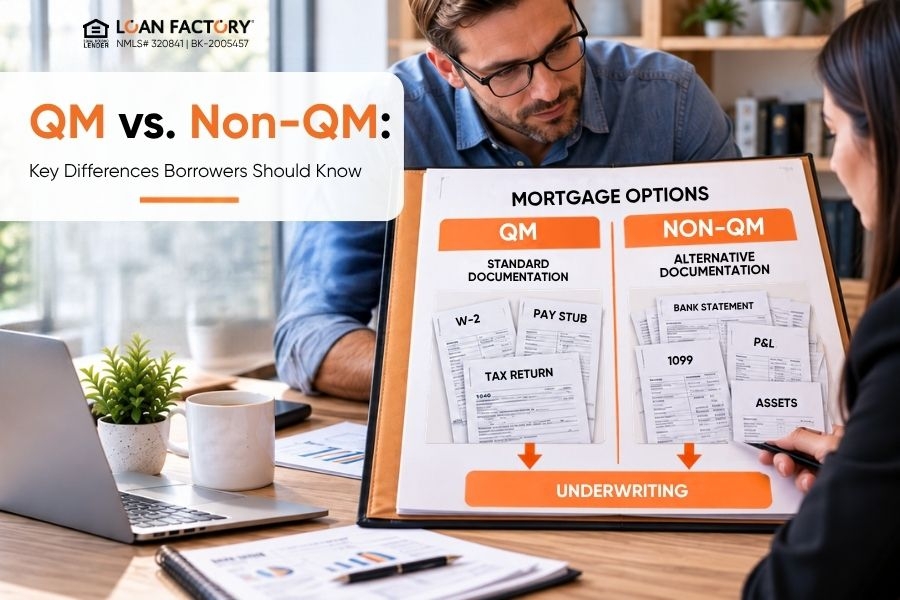
What are Non-QM loans ? A Non-QM loan is a mortgage that does not satisfy all the federal criteria required to be classified as a Qualified Mortgage, or QM.
Non-QM mortgages may use alternative methods to document income, assets, or rental-property cash flow. They can help self-employed borrowers, business owners, investors, retirees, and others whose finances do not fit standardized mortgage guidelines. Non-QM does not mean no underwriting, no documents, or guaranteed approval.
Key Takeaways Non-QM means non-qualified mortgage, not an unqualified borrower or an illegal mortgage. Most consumer-purpose Non-QM lenders must still make a reasonable, good-faith determination that the borrower can repay the loan. Alternative documentation may include bank statements, 1099 income, profit and loss statements, liquid assets, or other verified financial records. Real estate investors may use DSCR programs that evaluate the property’s rental income rather than relying primarily on personal employment income. Non-QM guidelines vary considerably among lenders because the programs are not standardized like agency mortgages. A Non-QM mortgage may involve different rates, fees, down payment, equity, reserve, or credit requirements. Non-QM loans are not automatically subprime, no-document, or interest-only loans. Borrowers should compare a Non-QM option with conventional, FHA, VA, USDA, Jumbo, and other available programs before making a decision. Important Note: Non-QM programs, alternative documentation, rates, APRs, points, fees, down payment, loan-to-value limits, reserves, credit standards, prepayment terms, property eligibility, and underwriting requirements vary by lender, investor, borrower, property, occupancy, and loan purpose. This article is informational and is not a commitment to lend.
What Does Non-QM Mean? Non-QM stands for non-qualified mortgage. The term describes a mortgage that falls outside one or more requirements used to classify a loan as a Qualified Mortgage under federal Regulation Z.
A Qualified Mortgage receives certain legal protections when it satisfies applicable product, underwriting, pricing, and points-and-fees requirements. A lender is not required to make only Qualified Mortgages, but most covered residential mortgage lenders must still follow the federal Ability-to-Repay rule.
“Non-Qualified” Does Not Describe the Borrower The term does not mean that the borrower is financially irresponsible or unqualified to own a home.
A financially strong borrower may need a Non-QM mortgage because:
Tax returns do not reflect current business cash flow. Income comes from several businesses or contracts. The borrower receives 1099 income instead of W-2 wages. Wealth is held in investment or retirement accounts. Rental-property income is more relevant than personal income. The borrower has a limited U.S. credit or residency profile. A recent credit event does not meet an agency waiting period. The requested loan structure is outside standard QM requirements. The lender must still determine whether the borrower and transaction satisfy the specific Non-QM program.
What Is a Qualified Mortgage? A Qualified Mortgage is a mortgage that meets a defined set of federal standards intended to support responsible underwriting and limit certain risky loan features.
Depending on the applicable QM category, relevant standards may address:
Verification of income and debts Loan term Amortization structure Points and fees Interest-rate calculation APR relative to a benchmark rate The borrower’s ability to repay General Qualified Mortgages generally cannot include negative amortization, interest-only payments, most balloon-payment structures, a term longer than 30 years, or points and fees above the applicable limit.
Does a Qualified Mortgage Have a 43% DTI Limit? Not necessarily.
The previous General QM definition used a 43% debt-to-income limit. The CFPB later replaced that fixed DTI test with price-based thresholds for the current General QM definition.
Lenders still evaluate income, debts, payment capacity, and other underwriting factors, but it is inaccurate to say that every current QM mortgage is universally limited to 43% DTI.
Qualified Mortgage vs. Non-Qualified Mortgage The main difference is whether the mortgage satisfies all the requirements of an applicable QM category.
Feature
Qualified Mortgage
Non-QM Mortgage
Federal classification Meets an applicable QM definition Does not meet every QM requirement Ability-to-repay review Required for covered loans Generally still required for covered consumer loans Income documentation Usually standardized and fully verified May use verified alternative documentation Product structure Must satisfy applicable QM restrictions May offer structures outside QM limits Points and fees Subject to applicable QM limits May fall outside QM limits, subject to other laws Loan term Generally no more than 30 years for QM status Some programs may offer different terms Interest-only feature Generally not permitted for General QM May be available through some Non-QM programs Lender guidelines More standardized Vary significantly among lenders Pricing Often broader agency or government pricing May reflect added documentation or credit risk Secondary market May be agency-eligible or government-backed Commonly funded through private investors or portfolios
A Non-QM loan is not automatically better or worse. It uses a different underwriting and risk framework.
For a more detailed side-by-side comparison, review Qualified Mortgage vs. Non-QM , including differences in qualification, documentation, loan features, and borrower considerations
Does a Non-QM Lender Verify Ability to Repay? Generally, yes, for covered consumer-purpose mortgages.
The federal Ability-to-Repay rule requires most lenders to make a reasonable, good-faith determination that a consumer can repay a covered residential mortgage according to its terms. The lender must generally consider and document factors such as income or assets, employment, credit history, monthly debts, and mortgage-related expenses.
Non-QM Is Not the Same as No-Doc Lending A legitimate Non-QM lender may use alternative documentation, but it still needs reliable information supporting the underwriting decision.
Depending on the program, this may include:
Personal bank statements Business bank statements Forms 1099 Profit and loss statements Asset statements Rental agreements Appraisal market-rent schedules Business ownership documentation Credit reports Reserve verification Property and insurance documents The documentation path may be different from a conventional mortgage, but it is not necessarily simpler.
Important Exception for Business-Purpose Loans Some mortgages secured by non-owner-occupied investment property may be classified as business-purpose credit rather than consumer credit.
These transactions can follow different federal requirements from owner-occupied consumer mortgages. DSCR loans are frequently marketed within the Non-QM category, but the precise ATR/QM treatment depends on the loan purpose, occupancy, borrower, and legal structure.
Borrowers should ask whether a proposed loan is:
Consumer-purpose or business-purpose Owner-occupied or non-owner-occupied Subject to the federal Ability-to-Repay rule Subject to a prepayment penalty Made to an individual or business entity Who May Consider a Non-QM Loan? Non-QM mortgages are generally designed for borrowers with the ability to repay but whose income, assets, credit history, property, or transaction does not fit a standardized mortgage program.
Self-Employed Borrowers Business owners may have strong cash flow while reporting reduced taxable income after legitimate business expenses and deductions.
A Non-QM lender may evaluate eligible deposits, business revenue, or current financial statements rather than relying exclusively on adjusted taxable income.
Independent Contractors and 1099 Earners Freelancers, consultants, sales professionals, gig workers, and independent contractors may receive irregular income across several clients.
A 1099-based or bank-statement program may provide another way to document qualifying income.
Real Estate Investors An investor may own multiple financed properties or have tax returns affected by depreciation and property expenses.
A DSCR loan may focus primarily on whether a rental property’s eligible income can support its proposed housing payment.
Asset-Rich Borrowers Retirees, investors, and high-net-worth borrowers may hold substantial liquid assets without receiving regular employment income.
An asset-depletion or asset-qualifier program may convert eligible assets into a calculated monthly income amount under the lender’s rules.
Borrowers With Recent Credit Events Some Non-QM lenders may consider borrowers after:
Bankruptcy Foreclosure Short sale Deed in lieu Mortgage delinquency Other significant credit events Availability depends on the event, time elapsed, re-established credit, down payment or equity, reserves, and lender guidelines.
Foreign Nationals and ITIN Borrowers Some participating lenders offer programs for borrowers who do not fit standard U.S. citizenship, residency, credit, or tax-documentation frameworks.
Requirements vary significantly and may include alternative credit references, larger asset documentation, foreign-income records, or specific occupancy restrictions.
A borrower’s status must be reviewed under the exact lender program rather than assumed from a general Non-QM category.
7 Common Types of Non-QM Loans Non-QM is an umbrella term rather than one mortgage product. Each program uses a different method to evaluate income, assets, property cash flow, or credit risk.
1. Bank Statement Loans A bank statement mortgage allows an eligible self-employed borrower to document income using deposits shown on personal or business bank statements.
The lender may review:
A specified number of monthly statements Eligible business or personal deposits Transfers between accounts Nonbusiness deposits Business expenses Ownership percentage Revenue consistency Large or unusual transactions The lender generally excludes deposits that do not represent qualifying business income, such as transfers, loan proceeds, tax refunds, or unverifiable funds.
Business Bank Statement Analysis When business statements are used, the lender may apply an expense factor to estimate the portion of gross deposits remaining after operating expenses.
The expense factor can be determined through:
A standard program percentage A current profit and loss statement A third-party business expense analysis Another lender-approved method Program rules vary, so the same deposits may produce different qualifying-income results at different lenders.
Learn more about bank statement loans , including how eligible deposits and business expenses may be evaluated.
2. Profit and Loss Statement Loans A P&L-only or P&L-based mortgage may evaluate business income using a profit and loss statement prepared or reviewed according to the lender’s requirements.
The lender may also request:
Business bank statements Business license Proof of ownership Accountant or tax-preparer letter Current balance sheet Evidence that the business remains active Additional third-party verification A P&L mortgage is not automatically a one-page approval. The lender must determine whether the financial statement is reliable and whether the reported income is stable and sufficient.
Learn more about P&L mortgage loans and how lenders may evaluate profit-and-loss documentation for business owners.
3. 1099 Income Loans A 1099 income loan program may calculate qualifying income using IRS Forms 1099 and supporting financial records rather than relying exclusively on traditional W-2 wages or a complete tax-return analysis.
Potential documentation may include:
One or more years of Forms 1099 Year-to-date income records Bank statements Verification of current contracts Proof of business activity Expense adjustment Credit and asset documentation A 1099 form shows gross compensation. The lender may apply an expense factor before determining the income available for qualification.
4. Asset-Depletion or Asset-Qualifier Loans An asset-based program may calculate monthly qualifying income from eligible liquid assets.
Potential assets may include:
Checking and savings accounts Brokerage accounts Stocks and bonds Money-market funds Vested retirement accounts Other eligible financial assets The lender may subtract:
Down payment Closing costs Required reserves Ineligible assets Applicable account penalties A percentage of market value Funds needed for other obligations The remaining eligible assets are divided over a program-defined period to establish calculated monthly income.
The exact formula differs by lender and should not be estimated without reviewing the program’s written guidelines.
5. DSCR Loans A Debt Service Coverage Ratio loan is commonly used for non-owner-occupied rental properties.
Instead of qualifying primarily through the investor’s personal employment income, a DSCR lender may compare the property’s eligible rental income with its proposed housing expense.
A simplified formula is:
Eligible monthly rental income ÷ qualifying monthly property payment = DSCR
The qualifying payment may include:
Principal Interest Property taxes Homeowners insurance HOA dues Other required property expenses The lender determines which rental-income and expense figures can be used.
Review the Loan Factory DSCR loan program for more information about investment-property qualification.
Illustrative Calculation: If eligible rent is $3,000 and the qualifying property payment is $2,500, the simplified DSCR is 1.20. This example is educational only. Lenders use program-specific definitions, appraisal documentation, vacancy treatment, and expense calculations.
6. Interest-Only Non-QM Loans Some Non-QM mortgages permit interest-only payments for an initial period.
During the interest-only phase, the scheduled payment may not reduce the principal balance. When the interest-only period ends, the payment may increase because the remaining principal must be repaid over a shorter amortization period.
Borrowers considering this structure can review how an interest-only mortgage works, including its payment structure, potential benefits, costs, and risks.
Before choosing this structure, review:
Interest-only period Fully amortizing payment Rate-adjustment terms Principal balance after the initial period Maximum possible payment Prepayment terms Expected ownership period Refinance risk A smaller initial payment does not necessarily mean the loan costs less.
Payment Disclosure: An interest-only loan may produce a smaller scheduled payment during the interest-only period, but the principal balance may not decline. Future payments can increase. Terms depend on the mortgage agreement, market conditions, underwriting, and investor guidelines.
7. Recent Credit Event or Expanded-Credit Loans Some Non-QM lenders may consider borrowers who do not satisfy the waiting periods or credit requirements of another mortgage program.
The underwriter may evaluate:
Reason for the credit event Time elapsed Re-established payment history Current credit score Down payment or equity Reserves Income stability Housing payment history Compensating factors A flexible waiting period does not mean that the credit event is ignored. Pricing, equity requirements, and documentation may reflect the additional risk.
What Documents Do Non-QM Lenders Require? The required documents depend on the program. A bank statement borrower, asset-based borrower, and rental-property investor will not submit the same income package.
Identity and Credit Government-issued identification Social Security number or eligible tax-identification information Credit authorization Address and housing history Explanation of significant credit events Income or Financial Capacity Bank statements Forms 1099 Profit and loss statements Asset statements Business ownership records Accountant or tax-preparer verification Employment verification Lease agreements Appraisal market-rent forms Other approved financial records Assets and Closing Funds Checking and savings statements Brokerage or retirement statements Documentation for large deposits Down payment funds Closing-cost funds Required reserves Gift or business-fund documentation when permitted Property and Transaction Purchase agreement Property appraisal Homeowners insurance Title documents HOA or condo records Current leases Entity documents for eligible investor transactions Existing mortgage statements for refinances The lender may request additional documentation after reviewing the initial file.
For a broader preparation guide, review the mortgage application document checklist before beginning the application process.
What Are Typical Non-QM Loan Requirements? There is no universal Non-QM qualification standard. Each lender and investor establishes its own credit, income, property, and loan-structure rules.
The lender may evaluate:
Qualification factor
What may be reviewed
Credit Score, recent payment history, credit events, mortgage history Down payment or equity Loan-to-value ratio and borrower investment Income documentation Bank statements, 1099s, P&L, assets, leases, or full documentation Reserves Funds remaining after closing Property Type, value, condition, occupancy, marketability Loan purpose Purchase, rate-and-term refinance, or cash-out Business history Length and stability of self-employment Rental cash flow Eligible rent compared with property payment Debt obligations Monthly liabilities and proposed payment Loan features Fixed, adjustable, interest-only, amortizing, or other structure
Stronger credit, lower loan-to-value, documented reserves, and stable financial history may improve the available terms, but they do not guarantee approval.
For loans that evaluate personal debt obligations, borrowers can review how lenders calculate debt-to-income ratio for a mortgage . Non-QM programs may apply their own qualification standards.
Do Non-QM Loans Require Tax Returns? Not always.
Certain bank statement, P&L, 1099, asset-based, or DSCR programs may not use personal tax returns to calculate qualifying income. However, a lender can still request tax documents for another purpose or require them under a particular program.
“No tax returns used for income qualification” is different from:
No income verification No financial review No IRS documentation No proof of business No underwriting Ask the lender exactly which documents are required before selecting a program.
Are Non-QM Loans More Expensive? They can be.
Non-QM mortgages may involve different pricing because they use alternative documentation, private investor guidelines, specialized property rules, or loan features outside the QM framework.
Potential cost differences may include:
Interest rate APR Discount points Origination charges Down payment Required equity Reserves Appraisal requirements Prepayment terms Mortgage insurance or lender-specific fees The cost difference depends on the borrower and loan structure. Do not assume every Non-QM offer has the same pricing.
Borrowers comparing lender charges can review what a loan origination fee covers and how it differs from discount points and other origination charges.
Compare More Than the Interest Rate Review:
Note rate APR Points Lender credits Origination fees Monthly payment Initial and future payment Loan amount Cash to close Prepayment penalty Interest-only period Balloon feature Total interest Expected refinance timeline A loan with a smaller initial payment may have a higher future payment or leave the principal balance unchanged.
Borrowers should also understand cash to close vs. closing costs when comparing the total upfront amount required by different Non-QM offers.
Can a Non-QM Loan Have a Prepayment Penalty? Some business-purpose investment-property programs may include a prepayment penalty, subject to applicable federal and state law.
The penalty may apply when the borrower sells, refinances, or pays down the mortgage during a specified period.
Before accepting the loan, review:
Penalty period Penalty calculation Whether partial principal payments trigger it Whether selling the property triggers it State restrictions Available no-penalty pricing Break-even period Planned investment exit Owner-occupied consumer mortgages are subject to different restrictions, so do not assume the same prepayment terms apply to every Non-QM loan.
Are Non-QM Loans the Same as Subprime Mortgages? No. The terms overlap in some public discussions, but they do not mean the same thing.
A Non-QM mortgage is defined by whether the loan meets the federal Qualified Mortgage criteria. It is not defined solely by the borrower’s credit score.
A Non-QM borrower may have:
Strong credit Significant reserves A large down payment Substantial assets A profitable business Multiple rental properties Complex but verifiable income Some Non-QM programs also serve borrowers with credit challenges, but that does not make every Non-QM mortgage subprime.
No.
Non-QM refers to the federal Qualified Mortgage classification.
Non-conforming generally means the mortgage does not meet the requirements for purchase by Fannie Mae or Freddie Mac.
A loan can be:
Non-conforming but still a Qualified Mortgage Non-QM and non-conforming Jumbo and QM Jumbo and Non-QM Government-backed and QM under its applicable framework The terms describe different aspects of the mortgage.
Are Non-QM Loans Government-Backed? Generally, the private Non-QM programs discussed in this article are not FHA-insured, VA-guaranteed, USDA-guaranteed, or purchased as standard agency mortgages.
They are commonly funded, purchased, or held by:
Private mortgage investors Portfolio lenders Banks Credit unions Specialized wholesale lenders Private securitization markets This is one reason guidelines can differ significantly among Non-QM loan lenders.
Pros and Cons of Non-QM Loans Potential Benefits Alternative Income Documentation A borrower may qualify using records that better reflect current cash flow or financial capacity.
More Program Variety Non-QM lenders may offer options for self-employed borrowers, investors, foreign nationals, asset-rich households, and borrowers recovering from credit events.
Flexible Property or Occupancy Options Some lenders finance investment properties, nontraditional property types, or transactions that do not fit agency guidelines.
Different Underwriting Approach The lender can evaluate the borrower under a specialized program rather than forcing the file into a standardized W-2 and tax-return model.
Potential Drawbacks Different Pricing Rates, points, fees, and required borrower equity may be less favorable than an available QM option.
Larger Down Payment or More Equity Some programs require a stronger borrower investment to offset alternative documentation or credit risk.
Reserve Requirements The borrower may need to retain several months of eligible payments after closing.
More Complex Underwriting Alternative documentation can require detailed deposit, expense, business, asset, or rental-income analysis.
Lender Guidelines Vary A borrower who qualifies with one lender may not satisfy another lender’s program.
Prepayment Restrictions Certain business-purpose investor loans may include a prepayment penalty.
Future Refinance Risk A borrower planning to refinance later must still qualify under future rates, property values, income, equity, and program availability.
When Might a Non-QM Loan Make Sense? A Non-QM loan may deserve consideration when the borrower can support the mortgage but the available financial documentation does not fit another program.
Possible situations include:
Tax returns understate current business cash flow. The borrower earns most income through 1099 contracts. Liquid assets are substantial, but regular employment income is limited. A rental property produces sufficient cash flow. A recent credit event prevents agency eligibility. Foreign income or credit requires specialized review. The requested property or transaction falls outside standard guidelines. A Non-QM option should usually be compared with all available QM and government-backed programs first.
When May a Non-QM Loan Not Be the Best Fit? A Non-QM mortgage may be less suitable when:
W-2 income and tax returns support an available conventional home loan with terms that better fit the borrower’s situation. The borrower can qualify for FHA, VA, USDA, or another appropriate program. The added down payment would deplete emergency savings. The payment is affordable only during an interest-only period. The borrower plans to sell or refinance before a prepayment penalty ends. The borrower has not reviewed the fully amortizing payment. The transaction depends on future appreciation. The borrower does not understand the income-calculation method. The available Non-QM pricing does not justify the flexibility. The goal is not merely to qualify. The mortgage must also fit the borrower’s budget, property plan, and expected ownership period.
How to Compare Non-QM Loan Lenders Because guidelines vary widely, comparing lenders can materially change the available loan structure.
1. Confirm the Income Method Ask whether the lender uses:
Personal bank statements Business bank statements 1099 income P&L income Full tax returns Asset depletion DSCR A combination of income sources 2. Ask How Income Is Calculated For a bank statement program, ask:
Which deposits are eligible? Which deposits are excluded? What expense factor applies? Can a P&L support a different expense ratio? How are transfers treated? How is ownership percentage applied? 3. Compare the Same Loan Structure Use the same:
Loan amount Property value Occupancy Loan purpose Term Fixed or adjustable structure Interest-only period Prepayment option Lock period Documentation type 4. Review the Complete Cost Compare:
Rate APR Points Lender fees Credits Payment Cash to close Reserves Prepayment penalty Future payment adjustments 5. Confirm Property Eligibility Ask whether the lender accepts:
Primary residences Second homes Investment properties Condominiums Condotels Two- to four-unit properties Properties owned by an LLC Short-term rentals Rural properties Mixed-use properties 6. Review Credit-Event Requirements Do not rely on a general claim that recent bankruptcy or foreclosure is permitted.
Confirm:
Required waiting period Maximum LTV Reserve requirement Housing payment history Credit-score requirement Pricing adjustment 7. Ask Who Funds and Services the Loan The mortgage may be funded, purchased, or serviced by different companies.
Review the Loan Estimate, closing documents, payment instructions, and servicing-transfer notices carefully.
Compare the full program: Request Non-QM mortgage options based on your income structure, property, occupancy, assets, and loan purpose.
Non-QM Loan Application Checklist Before Applying Review conventional and government-backed options. Identify why standard documentation does not fit. Choose the most appropriate alternative-income method. Review credit reports. Estimate down payment and reserves. Gather property information. Ask about prepayment terms. Income or Financial Documents Bank statements Forms 1099 Profit and loss statement Asset statements Business ownership records Business license Current contracts or invoices Rental leases Other lender-requested records Property and Transaction Purchase agreement Property address Intended occupancy Current leases Insurance information HOA or condo documents Entity documents when applicable Current mortgage statement for a refinance Before Closing Compare the Loan Estimate. Confirm whether the rate is locked. Review the fully amortizing payment. Confirm the interest-only period. Review any prepayment penalty. Verify closing funds and reserves. Avoid opening new credit. Review the Closing Disclosure. How Loan Factory Helps With Non-QM Mortgages Loan Factory is a technology-powered mortgage platform helping borrowers compare mortgage options through a broad wholesale lender network.
Loan Factory offers access to Non-QM, bank statement, DSCR, P&L, asset-based, 1099, foreign national, investor, and other mortgage programs, depending on borrower eligibility and participating lender availability.
A licensed Loan Officer can help you:
Compare QM and Non-QM alternatives Identify an appropriate income-documentation method Compare bank statement expense calculations Review P&L, 1099, asset, or rental-income options Evaluate down payment, equity, and reserve requirements Compare fixed, adjustable, amortizing, and interest-only structures Review prepayment terms for eligible investment loans Compare rates, APRs, points, fees, credits, payment, and cash to close Upload documents securely through TERA Track available application and underwriting milestones Compare Non-QM loan lenders and programs , or start an online mortgage application . Call or text (660) 333-3333 for direct assistance.
Is a Non-QM Loan Right for You? A Non-QM mortgage may be useful when you have a documented ability to repay but do not fit the income, credit, property, or product requirements of a standardized mortgage.
The strongest Non-QM application generally combines reliable alternative documentation with acceptable credit, sufficient equity, verified closing funds, appropriate reserves, and a property that fits the lender’s program.
Before proceeding, compare the Non-QM option with every mortgage for which you may qualify. Review the initial payment, future payment, rate, APR, points, fees, prepayment terms, loan balance, and long-term cost.
Apply online to begin reviewing your documentation, or call or text (660) 333-3333 to discuss available mortgage structures.
Experience Note The program descriptions, income methods, comparison tables, and application checklists in this article are educational illustrations based on common Non-QM, alternative-documentation, self-employment, asset-based, investment-property, and mortgage-underwriting considerations.
They do not represent a specific Loan Factory borrower, lender guideline, income calculation, rate quote, preapproval, approval, closing, or funded mortgage. Actual requirements and results vary by lender, investor, borrower, property, occupancy, loan purpose, and applicable law.
Sources About the Author Loan Factory Mortgage Education Team
Loan Factory is a technology-powered mortgage platform helping borrowers compare mortgage options through a broad wholesale lender network.
The Loan Factory Mortgage Education Team helps self-employed borrowers, business owners, investors, asset-rich households, and other mortgage applicants understand alternative income documentation, Non-QM underwriting, loan costs, property requirements, and lender comparisons.
Disclaimer This content is for educational and informational purposes only and is not financial, tax, legal, credit, accounting, investment, real estate, insurance, or housing-counseling advice. It is not a commitment to lend or a guarantee of eligibility, income acceptance, approval, rates, APRs, payments, loan terms, closing, or funding.
Non-QM programs, income-calculation methods, credit requirements, down payments, loan-to-value limits, reserves, rates, points, fees, prepayment terms, property eligibility, disclosures, and underwriting requirements vary by lender, investor, borrower, property, occupancy, state, and loan purpose.
Certain investment-property loans may be treated as business-purpose credit and can be subject to different federal or state requirements from owner-occupied consumer mortgages. Consult appropriately licensed mortgage, tax, legal, and financial professionals regarding your circumstances.
Frequently Asked Questions