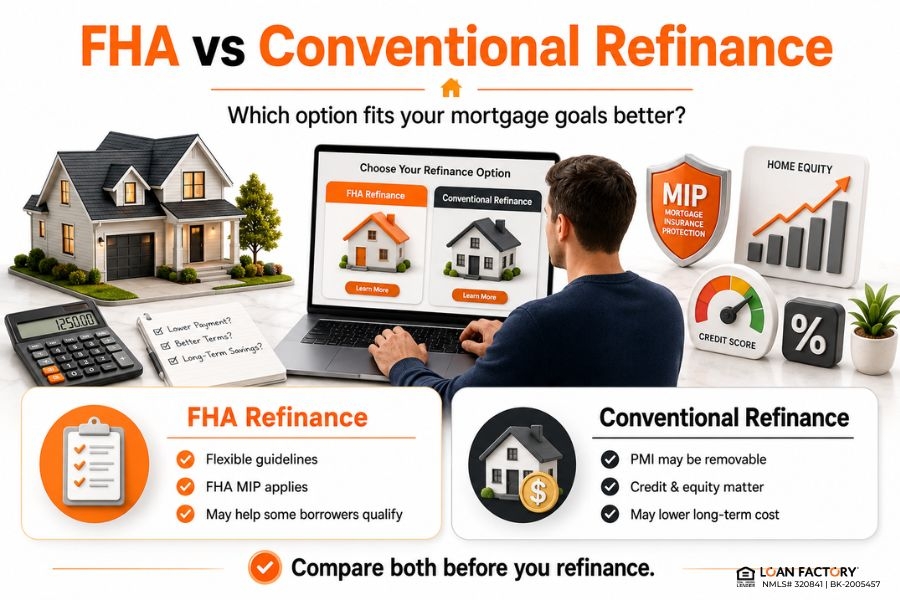
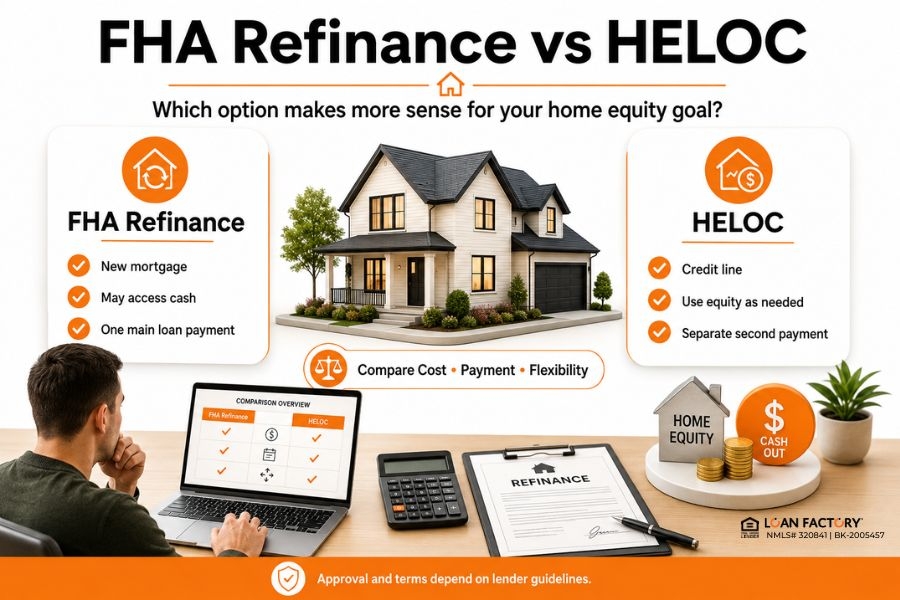
An FHA Cash-Out Refinance lets homeowners replace their existing mortgage with a larger FHA-backed loan and take the difference in cash.
Example: If your home is worth $400,000 and you owe $250,000, you may refinance up to 80% of your home’s value — or $320,000.
You can use this money for home renovations, debt consolidation, tuition, or any other major expense — FHA doesn’t restrict your cash-out purpose.
→ Read more: Home Loan Refinance: Is Now the Right Time for You to Check Your Rate?
2025 FHA Cash-Out Example (Updated Numbers) According to recent mortgage data (Ainvest, 2025 ):
Item
Example
Home Value $400,000 Current Loan Balance $250,000 Max FHA LTV 80% ($320,000) Estimated Cash-Out $70,000 Closing Costs (2–5%) ~$5,000 Net Cash to Borrower ~$65,000 Estimated Rate (2025) ~6.50%–6.80% (with MIP)
You’ll still keep 20% equity ($80,000) in your home.
But note: You’ll pay FHA Mortgage Insurance Premiums (MIP) — both upfront and annually. (LendEDU )
FHA Cash-Out Requirements Requirement
FHA Standard
Residency Must be your primary home, not investment property. Occupancy Live in the home at least 12 months. Loan-to-Value (LTV) Max 80% of appraised value. Credit Score Minimum 500, but 620+ preferred. Debt-to-Income (DTI) Typically under 43%. Payment History On-time for past 12 months. Loan Limits Must fall within local FHA loan limits.
Pros and Cons of FHA Cash-Out Benefits Easier to qualify than conventional loans Lower credit score requirements Flexible use of funds (renovation, debt payoff, tuition, etc.) Replaces a higher-rate loan with a new, possibly better term Drawbacks Adds new debt by increasing your loan balance Requires Mortgage Insurance (MIP) even with 20% equity Higher closing costs (2–6% of loan) Could reduce your home equity buffer if property values fall -> Read more: Cash-Out Refinance: A Complete Guide for Consumers
When Does FHA Cash-Out Make Sense? Good idea when: You have 20%+ equity and need funds for valuable purposes (renovation, debt payoff) You want to switch from a high-interest loan You can’t qualify for a conventional refinance due to credit or DTI Not ideal when: Your current mortgage rate is lower than today’s (~6.5%) You already have limited equity You qualify for a conventional cash-out (to avoid MIP) Want to see if FHA Cash-Out fits your goals? Get a real-time quote now »
FHA vs. Conventional Cash-Out in 2025 Feature
FHA Cash-Out
Conventional Cash-Out
Credit Score 500–620+ 660+ Max LTV 80% 80% Mortgage Insurance Required (MIP) Required if <80% equity Typical Rate (2025) ~6.5–6.8% ~6.25–6.5% Flexibility Easier qualification Lower cost if strong credit
Why Choose Loan Factory for FHA Cash-Out Refinancing At Loan Factory, we combine AI-powered technology with access to 240+ wholesale lenders — giving you instant side-by-side comparisons and the Best Price Guarantee.
Why homeowners choose us:
240+ lenders for real-time rate shopping AI-powered MOSO platform for faster approvals Local loan advisors offering personal support Zero application or junk fees Trusted by Thuan Nguyen – #1 Loan Officer in the U.S. The FHA Cash-Out Refinance can be a powerful tool to unlock home equity — especially if you have moderate credit or need flexible funds.
Just make sure to compare rates and weigh insurance costs carefully.
Ready to see how much cash you can take out from your home?
Apply online: www.LoanFactory.com/apply
Check mortgage rates: www.LoanFactory.com/quote
Set up a rate alert: www.loanfactory.com/mortgage-rate-alert
For faster support, you can call or text us at (660) 333-3333
This content is for informational purposes only and not a commitment to lend. Loan terms, rates, and approval depend on credit, underwriting, and investor guidelines.
Frequently Asked Questions (FAQ)