The best app to monitor mortgage rates is one that does more than display a national average. It should provide quotes based on your loan scenario, let you set a target rate, notify you when that target becomes available, and help you compare the complete rate-and-cost structure before applying or locking.
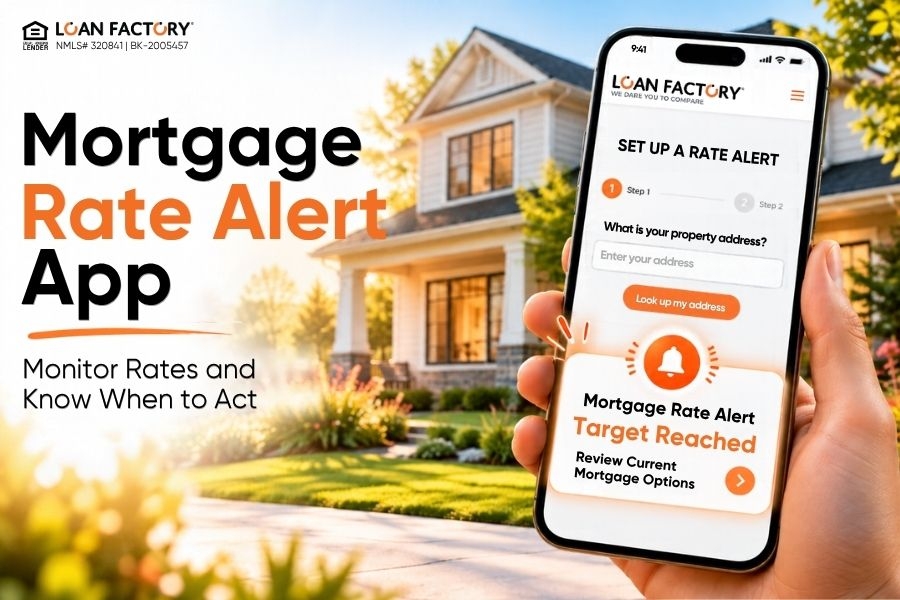
For buyers and homeowners who want those functions in one place, Loan Factory’s mortgage rate alert app provides personalized quotes, rate alerts, and a direct path to a mortgage application.
Key Takeaways National mortgage averages are useful for tracking market direction, but they are not personalized loan offers. A useful mortgage rate alert app should let you set a target based on your loan type, credit profile, property, down payment, or equity. Reaching your target rate does not automatically lock it or guarantee loan approval. Buyers should consider locking when the loan terms fit their budget and the lock period can cover the expected closing date. Homeowners considering refinancing should compare closing costs, the new loan term, payment changes, and the break-even period—not only the interest rate. Important Note: Mortgage rates can change during the day and depend on the borrower, property, loan program, market conditions, points, credits, and lender guidelines. A rate alert is informational and is not a commitment to lend, a rate lock, or a guarantee that a particular rate will be available.
What Should the Best Mortgage Rate App Do? The best mortgage rate app should turn market information into a practical next step. Instead of forcing users to repeatedly check a generic rate table, it should monitor relevant loan scenarios and notify the user when conditions approach a personalized goal.
A strong app should offer:
Personalized mortgage quotes Custom target-rate alerts Purchase and refinance scenarios Multiple loan-program options Payment or mortgage calculators Clear information about points and lender credits A direct way to request a formal quote Secure document upload or application access Loan-status tracking after applying Access to a licensed mortgage professional Loan Factory’s official rate-alert page identifies three core functions: real-time personalized quotes, the ability to create a rate alert, and an online application process. Its mobile app also supports loan-status tracking and personalized quote comparisons.
Why Is a Personalized Rate Alert Better Than a Generic Rate Chart? A generic rate chart shows broad market averages. A personalized rate alert is tied more closely to the type of mortgage you may actually qualify for.
The rate available to an individual borrower can be affected by:
Credit history and credit score Purchase or refinance purpose Loan program Loan term Property value or purchase price Down payment or equity Loan amount Primary, second-home, or investment occupancy Property type Discount points Lender credits Lock period The Consumer Financial Protection Bureau explains that mortgage pricing may change when the credit score, loan type, home price, down payment, and term change.
That means a national average of 6%, for example, does not establish that every borrower can obtain a 6% mortgage. It also does not show whether that rate includes discount points, a lender credit, a specific lock period, or other costs.
Market Average vs. Personalized Quote Information type
What it tells you
Main limitation
National average General market direction Not based on your loan profile Advertised rate A lender’s selected example May require specific assumptions Personalized quote Estimated pricing for your scenario Can still change before a formal lock Loan Estimate Detailed terms and estimated costs after applying Must be compared with equivalent offers Locked rate Protected for a defined period under stated conditions May expire or change if the application changes
Freddie Mac’s Primary Mortgage Market Survey is a widely used benchmark for weekly 30-year and 15-year fixed mortgage averages. It is helpful for understanding market trends, but it does not represent a personalized quote for an individual borrower.
What Is a Mortgage Rate Alert App? A mortgage rate alert app monitors mortgage pricing and sends a notification when a selected rate or market condition is reached.
Depending on the platform, the user may enter:
Purchase or refinance Target interest rate Loan amount Property value Down payment or equity ZIP code Occupancy Loan type Estimated credit range Preferred loan term A basic alert app may monitor only a national index. A more useful app connects the target to a personalized mortgage scenario.
Loan Factory allows users to create a target-rate alert so they can be notified when rates reach the selected goal. Its official materials also connect the alert with personalized quotes and mortgage application tools.
What a Rate Alert Does Not Do A mortgage rate alert does not automatically:
Approve the borrower Verify income or assets Confirm the property’s value Lock the interest rate Guarantee a closing date Guarantee a particular payment Confirm the final APR or closing costs The alert should be treated as a signal to review current options—not as a completed mortgage agreement.
The best tool depends on what the user wants to accomplish.
User goal
Most useful tool
Understand broad mortgage-market direction Freddie Mac weekly average data Follow daily housing and mortgage news Mortgage market news app Monitor a personal purchase target Personalized mortgage rate alert app Watch for a refinance opportunity Alert linked to the current balance, equity, and desired payment Compare actual lender costs Formal quotes and Loan Estimates Follow mortgage-backed securities intraday Professional mortgage-market monitoring tool Apply and track a loan Lender or mortgage-platform app
For most homebuyers and homeowners, a professional MBS trading app may provide more detail than they need. The more practical choice is usually an app that converts market movement into personalized loan scenarios.
Why Loan Factory Is a Strong Choice for Mortgage Rate Monitoring Loan Factory’s rate-alert system is designed for borrowers who want to move from monitoring to action without using separate tools for quotes, alerts, and applications.
Through Loan Factory, users can:
Review personalized mortgage quotes Create a mortgage rate alert Compare available loan options Apply through the mobile experience Monitor loan progress after applying The official Loan Factory app page states that borrowers can compare personalized quotes from multiple lenders, complete an application, and receive real-time loan-status notifications.
This structure may be useful for:
A buyer waiting for a target rate before making an offer A homeowner monitoring refinance opportunities A borrower comparing conventional, FHA, VA, or Non-QM options An investor watching pricing for a rental-property loan A homeowner evaluating a cash-out refinance or home-equity strategy Set up a free Loan Factory mortgage rate alert .
How Do You Set the Right Mortgage Rate Alert? The right target is not necessarily the lowest number seen in a headline. It should be connected to a payment, cash-to-close amount, refinance break-even point, or affordability goal.
For a Home Purchase A purchase alert can be built around:
Maximum comfortable monthly payment Target purchase price Available down payment Preferred loan program Estimated credit profile Property taxes and insurance Expected closing timeline Maximum points or upfront costs A small change in the interest rate may affect affordability, but taxes, insurance, mortgage insurance, HOA dues, and the purchase price can also materially change the total housing payment.
For a Refinance A refinance alert should consider:
Current mortgage rate Current unpaid balance Remaining loan term Proposed new term Current mortgage insurance Expected property value Desired cash-out amount Estimated closing costs Planned time in the home Monthly or total-cost goal A homeowner with 22 years left on the current mortgage should not compare only the existing rate with a new 30-year rate. Restarting the term may reduce the monthly payment while increasing the time over which interest is paid.
Use a Range Instead of One Exact Number A useful alert strategy may include:
A primary target rate A secondary “review now” threshold A maximum points or cost limit A payment target A deadline based on the expected purchase or refinance timeline For example, a borrower might ask to be notified when a 30-year fixed option approaches a selected rate with no more than a stated amount of discount points.
This is more meaningful than an alert that monitors the interest rate without considering costs.
Should You Set an Alert Based on Rate or APR? The interest rate is important, but it does not capture the complete cost of the mortgage. APR incorporates the rate and certain loan costs, although it also has limitations.
When comparing quotes, review:
Interest rate APR Discount points Lender credits Origination charges Mortgage insurance Monthly payment Cash to close Lock period The CFPB recommends comparing Loan Estimates from different lenders and reviewing both origination charges and the comparisons section.
A slightly different rate-and-cost combination may be more suitable when it preserves cash, reduces points, or aligns better with how long the borrower plans to keep the mortgage.
When Should a Homebuyer Apply? A buyer should generally begin the mortgage review before submitting an offer, particularly when the offer will depend on financing.
Applying early can help the buyer understand:
Potential loan programs Estimated purchase range Down payment requirements Closing costs Documentation needs Credit issues Property restrictions Whether assistance may be available A rate-monitoring app can help during this preparation period, but it should not replace financial qualification.
→ Read more: What are the closing costs on a mortgage
Rate Alert vs. Preapproval Rate alert
Mortgage preapproval
Monitors a pricing target Reviews financial qualification Does not reserve a rate Does not always include a rate lock May use estimated information Requires verified or reviewed application data Helps identify timing Helps support a purchase offer Does not guarantee approval Remains subject to property and final underwriting
A buyer who waits to apply until a rate alert triggers may discover missing documents, credit issues, or a different qualifying amount. Monitoring and mortgage preparation should happen together.
When Should You Lock a Mortgage Rate? A rate lock may be worth considering when the borrower has an active mortgage application, knows the expected closing date, and is comfortable with the quoted rate, payment, points, and closing costs.
A mortgage rate lock means the rate generally will not change between the lock and closing, provided the loan closes within the specified period and the application does not materially change. Mortgage rates can change daily or even during the same day.
Common lock periods include:
30 days 45 days 60 days Longer periods for selected transactions Questions to Ask Before Locking Ask the lender:
Is this quote currently locked? How long does the lock last? Does the lock have a fee? What happens if closing is delayed? How much does a lock extension cost? Can the rate change if the appraisal, credit, income, or loan amount changes? Is a float-down option available? What points or lender credits are included? The CFPB notes that lock policies vary and that extensions may be expensive if the transaction takes longer than expected.
Important: Receiving a notification from a mortgage rate alert app does not lock the rate. Contact the lender and obtain confirmation of the rate, costs, expiration date, and lock conditions.
Should You Wait for Rates to Improve Before Buying? Waiting may make sense for some buyers, but the decision should not be based on the rate alone.
While waiting:
Home prices may change. Available inventory may change. Rent payments continue. Buyer competition may increase or decrease. The borrower’s income or credit may change. The desired property may no longer be available. A buyer who can comfortably afford the payment and expects to remain in the property may decide to proceed even when the rate is not at a historic low. Another buyer may need a specific rate-and-cost combination to remain within budget.
A rate alert helps the buyer monitor a goal without checking manually every day, but it cannot determine whether purchasing is financially appropriate.
A homeowner should review refinancing when a new mortgage may improve the rate-and-cost structure, change the loan term, remove certain mortgage insurance, access equity, or replace a loan that no longer fits the homeowner’s goals.
Do not refinance only because the new interest rate is different.
Review:
Monthly payment change Total closing costs Points New loan balance New mortgage term Mortgage insurance Cash-out amount Break-even period Planned time in the home Total interest over the expected holding period Illustrative Break-Even Example Assume:
Estimated refinance costs: $6,000 Estimated monthly payment reduction: $250 No cash-out Homeowner expects to keep the new mortgage for several years $6,000 ÷ $250 = 24 months
The simplified break-even period is approximately 24 months. If the homeowner expects to sell or refinance again before then, the transaction may not recover its upfront costs.
Illustrative Example Disclosure: This simplified example is for informational purposes only and is not a commitment to lend or a savings guarantee. Actual rates, payments, costs, terms, taxes, insurance, mortgage insurance, and break-even results vary.
→ Read more: what happens when you refinance your home?
Can a Mortgage Rate App Tell You Whether Refinancing Is Worth It? An app can help identify when a refinance deserves review, but it cannot make the complete decision from the rate alone.
A useful refinance monitoring app should consider:
Current mortgage balance Current rate Remaining term Estimated home value Credit profile Occupancy New loan type Closing costs Desired cash out Target payment The final decision should use an actual quote and, after applying, a Loan Estimate showing the proposed rate, APR, payment, points, lender credits, and closing costs. The CFPB explains that a Loan Estimate contains the information needed to compare mortgage offers.
Why Do Mortgage Rates Change? Mortgage rates can move in response to changes in:
Inflation expectations Treasury yields Mortgage-backed securities Employment and economic data Federal Reserve policy expectations Investor demand Financial-market volatility Lender capacity and risk management However, the rate offered to a borrower also depends on personal and transaction-specific factors.
That is why two users checking the same app on the same day may see different mortgage options.
How Often Should You Check Mortgage Rates? You do not need to refresh mortgage-rate websites throughout the day.
A more practical approach is:
Use weekly average data to understand the broader trend. Create a personalized alert for the target scenario. Request a current quote when the alert triggers. Compare the quote with the payment and cost goal. Contact the lender when ready to apply or lock. Freddie Mac publishes its Primary Mortgage Market Survey weekly, while personalized lender pricing may change more frequently.
A mortgage rate monitoring app is most useful when it reduces repeated manual checking without encouraging a rushed decision.
Once an alert triggers, request the full scenario rather than asking only, “What is the rate?”
Confirm:
Item
Why it matters
Interest rate Determines interest charged on the balance APR Helps compare certain costs across offers Discount points Shows upfront cost paid for the pricing structure Lender credits May reduce closing costs but affect the rate Loan term Affects payment and long-term interest Lock period Must align with the expected closing timeline Mortgage insurance Can materially affect the monthly payment Estimated cash to close Shows the funds needed at closing Total monthly payment Includes more than principal and interest Prepayment penalty May affect the cost of paying off the loan early
The CFPB warns that lender credits may be connected to a different interest-rate structure and recommends comparing total costs, not just one headline number.
What Are Common Mortgage Rate App Mistakes? Choosing an App That Shows Only Headline Rates A headline rate may be based on assumptions that do not match the user’s credit, property, down payment, or loan program.
Setting an Unrealistic Target A target taken from an old mortgage statement or social media post may not reflect current market conditions or the borrower’s situation.
Ignoring Points A lower displayed rate may require substantial upfront discount points.
Treating an Alert as a Lock The rate remains subject to current pricing and lender confirmation until it is formally locked.
Waiting to Prepare Documents A rate may move before the borrower can complete the application and provide required information.
Monitoring Rate but Not Payment Taxes, insurance, HOA dues, mortgage insurance, and loan amount also affect affordability.
Refinancing Without Calculating Break-Even A different rate does not automatically create meaningful savings after closing costs and a new loan term are considered.
How Loan Factory Helps Loan Factory brings several mortgage-monitoring steps into one borrower experience.
Through the Loan Factory rate alert and mobile tools, borrowers may:
Review personalized quotes Create a target-rate alert Compare mortgage options Move from monitoring to an application Track the loan after applying Work with a licensed mortgage professional This is especially useful because the appropriate time to act depends on more than broad market averages. A Loan Officer can review the borrower’s credit profile, loan purpose, property, down payment or equity, points, costs, and closing timeline.
Loan Factory does not guarantee that a target rate will become available or that the borrower will qualify when an alert is triggered.
Create your personalized mortgage rate alert .
When your target is reached and you are ready for a complete review, you can also apply online or call or text (660) 333-3333.
Download the Loan Factory App The Loan Factory app gives you one convenient place to monitor mortgage rates, manage alerts, apply for financing, and follow your loan after submission.
With the Loan Factory app, you can:
Review personalized mortgage quotes Create and manage mortgage rate alerts Compare purchase and refinance options Complete your mortgage application Upload requested documents securely Review and e-sign available disclosures Track loan milestones and status updates Stay connected with your Loan Officer Monitor Rates and Know When to Take Action Set a target mortgage rate based on your homebuying or refinance goals. When your target is reached, you can review the current rate, APR, points, lender credits, payment, and estimated closing costs before deciding whether to apply or request a rate lock.
A rate alert does not automatically lock your rate. Current pricing must be confirmed by a Loan Officer and remains subject to your verified information, property details, market conditions, and loan-program requirements.
Track Your Loan After You Apply After submitting your application, the app helps you follow important stages of the mortgage process, which will include:
Application ready for submission Registered with the lender Disclosures ready for review and e-signature Lender and underwriting review Approved with conditions Clear to close Closing documents sent to the title or settlement company Loan funded Status updates help you understand where your loan stands, complete requested tasks, and prepare for the next step.
Download the Loan Factory app to monitor mortgage rates, manage alerts, apply online, and track your loan in one place.
You can also create a personalized mortgage rate alert or call or text (660) 333-3333.
Note: Available features, loan milestones, terminology, review times, and closing procedures can vary by lender, loan program, property location, device, and transaction. Rate alerts and status updates are not commitments to lend or guarantees of approval, closing, or funding.
Conclusion The answer to “What is the best app to monitor mortgage rates?” depends on what the user expects the app to do.
For general market direction, a weekly benchmark such as Freddie Mac’s survey may be enough. For purchase or refinance planning, the more useful option is a mortgage rate alert app that provides personalized quotes, target notifications, cost comparisons, and a clear path to apply or lock.
Loan Factory combines personalized rate monitoring, alerts, lender comparison, application tools, and loan tracking. The alert can tell you when it is time to review your options, but the final decision should be based on the complete rate, APR, points, credits, payment, closing costs, and loan term.
Set up your Loan Factory mortgage rate alert , download the Loan Factory app , or call or text (660) 333-3333 to review your purchase or refinance options.
Experience Note The evaluation framework in this article reflects common mortgage-rate monitoring, rate-alert, rate-lock, purchase, refinance, Loan Estimate, and break-even considerations.
It does not represent a specific Loan Factory borrower, personalized quote, rate lock, mortgage approval, refinance result, payment, or savings outcome.
Sources Loan Factory — Mortgage Rate Alert and mobile-app features, including personalized quotes, rate alerts, applications, and loan tracking. Consumer Financial Protection Bureau — Mortgage rate locks and circumstances that may affect locked pricing. Consumer Financial Protection Bureau — Loan Estimate review, lender-credit, points, payment, and mortgage-cost comparison guidance. Consumer Financial Protection Bureau — Factors that influence personalized mortgage rates. Freddie Mac — Primary Mortgage Market Survey and historical weekly mortgage-rate data. About the Author Loan Factory Mortgage Education Team
Loan Factory is a technology-powered mortgage platform helping borrowers compare mortgage options through a broad wholesale lender network.
The Loan Factory Mortgage Education Team helps homebuyers and homeowners understand mortgage-rate monitoring, personalized quotes, target alerts, rate locks, refinance timing, and mortgage-cost comparisons.
Disclaimer: This content is for educational and informational purposes only and is not financial, tax, legal, credit, accounting, real estate, or housing-counseling advice, a commitment to lend, or a guarantee of approval, savings, rates, payments, or closing outcomes. Mortgage rates, APRs, points, lender credits, payments, closing costs, lock terms, and eligibility vary by borrower, property, loan purpose, lender, location, market conditions, underwriting, and investor guidelines.
Frequently Asked Questions